Weather in French: Common Vocabulary, Expressions, and Sentences
Master French weather vocabulary with essential terms and phrases. Learn how to describe weather conditions, ask about the weather, and use fun idioms.
Discussing the weather in French is important for travelers and language learners. This article covers essential vocabulary, phrases, and idioms about weather. Knowing these terms helps in daily conversations and understanding weather forecasts, making interactions smoother and more enjoyable
Key Takeaways
- Know the French weather, and there are “Il fait” basics, beau (nice), chaud (hot), froid (cold), du vent (windy), or brouillard (foggy) for quick descriptions.
- Learn the Verbs nail actions such as pleut (rains), neige (snows), gèle (freezes), tonne (thunders), plus “Il y a” for soleil (sun) or nuages (clouds).
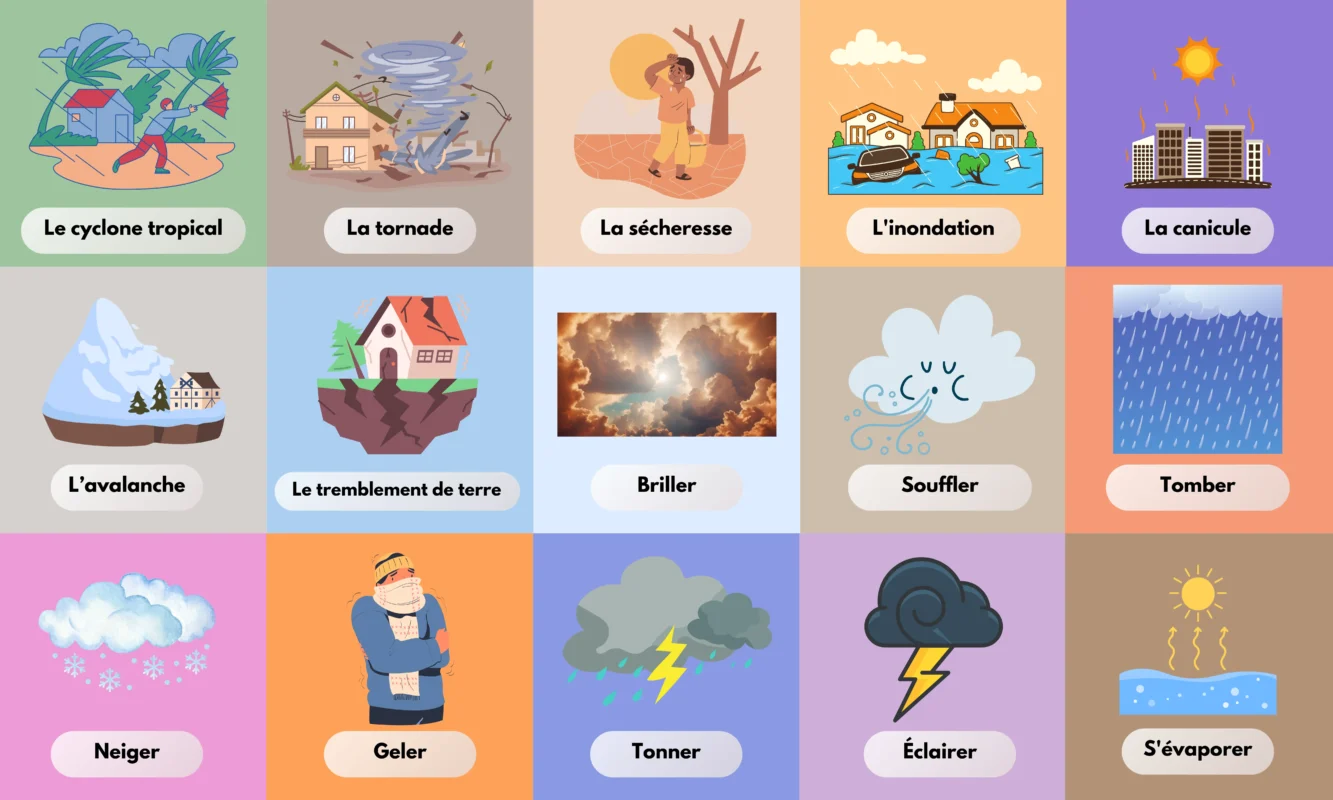
- There are extreme weather terms you can learn, such as tornado (tornado), canicule (heatwave), inondation (flood), or avalanche cover wild stuff.
- Here, you learn fun idioms related to weather, such as “pleut des cordes” (raining buckets), “froid de canard” (freezing cold), and “tête dans les nuages” (daydreaming).
- You can read more and learn more about the weather in French, and take Personal feels with “J’ai froid/chaud,” and extras like baromètre (barometer) or prévisions météo (forecast) for pro chats.
How to Ask About the Weather in French
Weather is most talked about in day-to-day French conversations. Weather forecast is the most important thing to look at as everything is planned in accordance to it. So, it becomes very important to learn how to ask questions such as –
Est-ce qu’il fait beau dehors ? – Is the weather nice outside?
Quel temps fait-il aujourd’hui ? -What is the weather like today?
Comment est le temps aujourd’hui ? – How is the weather today?
Quel temps fera-t-il demain ? – What will the weather be like tomorrow?
Est-ce qu’il va pleuvoir aujourd’hui ? – Is it going to rain today?
Weather Adjectives in French
In order to hold a conversation about weather in French, you need to know the words for adjectives such as sunny, cloudy, windy, etc. Just add il fait to it and you are all set!
Using “Il fait” is a common way to describe the weather in French. Here are some common adjectives:
| French Phrase | English Translation | Usage Example |
|---|---|---|
| Il fait beau | It’s nice out | Use this when the weather is pleasant and sunny. |
| Il fait chaud | It’s hot out | Say this when the temperature is high and it’s warm outside. |
| Il fait froid | It’s cold out | Use this when it’s chilly or cold outside. |
| Il fait mauvais | The weather is bad | Say this when the weather is unpleasant, like during rain or storms. |
| Il fait frais | It’s cool out | Use this when the weather is cool but not cold. |
French Weather with Nouns
Now that you know those, you need to learn the words for sun, snow, wind. This is also how words appear in weather reports. Here are some common examples of expressions built around weather nouns:
| French Phrase | English Translation | Explanation |
|---|---|---|
| Il fait du soleil | It’s sunny out | Use this when the sun is shining brightly. |
| Il fait du vent | It’s windy out | Say this when the wind is blowing strongly. |
| Il fait du brouillard | It’s foggy out | Use this when there is fog and visibility is low. |
| Il fait de l’orage | It’s stormy out | Say this when there is a thunderstorm with lightning and thunder. |
| Il fait de la pluie | It’s rainy out | Use this when it is raining. |
French Weather with Verbs
Apart from using il fait, you can directly use the verbs to form a sentence when it’s happening. For example, if you want to say It’s raining, you say il pleut. Verbs tell you what the weather is doing, whereas adjectives describe what the weather is like.
Weather-related verbs can describe conditions without using “fait.” Here are some common examples:
| French Verb | English Translation | Usage Example |
|---|---|---|
| Il pleut | It’s raining | Use this when it is raining. |
| Il neige | It’s snowing | Say this when it is snowing. |
| Il gèle | It’s freezing | Use this when temperatures are below freezing. |
| Il grêle | It’s hailing | Say this when hailstones are falling. |
| Il tonne | It’s thundering | Use this when there is thunder during a storm. |
Learning animal names in French can make conversations more engaging. Explore Animals in French.
French Weather with “Il y a”
Il y a is another way to describe the weather in French. The major difference between il fait and il y a being il fait describes how the weather feels, whereas il y a describes what is present in the weather.
Using “Il y a” is another way to describe weather conditions in French. Here are some common examples:
| French Phrase | English Translation | Description |
|---|---|---|
| Il y a du soleil | It’s sunny out | Use this when the sun is shining. |
| Il y a un arc-en-ciel | There’s a rainbow | Say this when a rainbow is visible. |
| Il y a une tempête | There’s a storm | Use this when a storm is occurring. |
| Il y a des nuages | It’s cloudy | Say this when the sky is covered. |
| Il y a du brouillard | It’s foggy | Use this when there is low visibility. |
French Weather Vocabulary
As we learn how to describe the weather, we have vocabulary that describes the elements of it, such as thunder and lightning among others.
Here are some frequently used weather-related nouns in French:
| French Word | English Translation | Definition |
|---|---|---|
| Le tonnerre | Thunder | The sound produced during a storm. |
| L’éclair | Lightning | The flash of light during a storm. |
| La pluie | Rain | Water that falls from clouds. |
| La neige | Snow | Frozen water crystals that fall from clouds. |
| La grêle | Hail | Small ice pellets that fall from clouds. |
| Le brouillard | Fog | A thick cloud that reduces visibility. |
| Le vent | Wind | Air moving quickly in the atmosphere. |
| Le soleil | Sun | The star that provides light and warmth. |
Expand your French vocabulary with essential environment and ecology terms to discuss sustainability, climate change, and conservation in everyday conversations and professional settings.
Weather Terms in French
French weather terminology describes both everyday vocabulary and more technical terms used in forecast. Learning these words helps learners understand weather reports, travel updates, seasonal conversations, and daily forecasts.
Here are some terms related to extreme weather conditions:
| French Term | English Translation | Explanation |
|---|---|---|
| Le cyclone tropical | Tropical cyclone | A powerful storm system with strong winds and heavy rain. |
| La tornade | Tornado | A violently rotating column of air extending from a thunderstorm to the ground. |
| La sécheresse | Drought | A prolonged period of abnormally low rainfall, leading to a shortage of water. |
| L’inondation | Flood | An overflow of water that submerges land which is usually dry. |
| La canicule | Heatwave | An extended period of excessively hot weather. |
| L’avalanche | Avalanche | A large mass of snow, ice, and rocks falling rapidly down a mountainside. |
| Le tremblement de terre | Earthquake | A sudden and violent shaking of the ground, often causing great destruction. |
Weather Verbs in French
Weather verbs in infinitive form and how to use it in a sentence will help you a lot to understand it better. These describe the action such as to shine or to fall.
Here are verbs commonly used to describe weather actions in French:
| French Verb | English Translation | Example in French | Example in English |
|---|---|---|---|
| Briller | to shine | Le soleil brille | The sun is shining |
| Souffler | to blow | Le vent souffle | The wind is blowing |
| Tomber | to fall | La pluie tombe | The rain is falling |
| Neiger | to snow | Il neige | It’s snowing |
| Geler | to freeze | Il gèle | It’s freezing |
| Tonner | to thunder | Il tonne | It’s thundering |
| Éclairer | to lighten | Le ciel s’éclaire | The sky is lighting up |
| S’évaporer | to evaporate | L’eau s’évapore rapidement | The water is evaporating quickly |
Lost for Words? We’ve Got You!
Sign up for our courses and let our expert teachers boost your vocabulary effortlessly!
French Weather Idioms
Every language has idioms describing the weather mostly extreme weather conditions, such as it’s raining cats and dogs to explain heavy rain. These idioms teach a lot about the culture in general.
French weather idioms add colorful expressions to conversations. Here are some popular examples:
| French Idiom | English Translation | Explanation |
|---|---|---|
| Il fait un temps de chien | It’s horrible weather | Describes very bad weather conditions. |
| Il pleut des cordes | It’s raining ropes | Means it’s raining heavily. |
| Il fait un froid de canard | It’s bitterly cold out | Describes extremely cold weather. |
| Avoir la tête dans les nuages | To have your head in the clouds | Means someone is daydreaming or not paying attention. |
| Être sous le soleil exactement | To be exactly under the sun | Means to be in a very fortunate or perfect situation. |
| Avoir le vent en poupe | To have the wind in one’s sails | Means to be on a winning streak or to have momentum. |
| Faire la pluie et le beau temps | To make the rain and the good weather | Means to have a lot of power or influence. |
Expressions for Talking About the Weather
Just as you don’t say Je suis for age instead we use j’ai as in I have instead, for expressions talking about weather and what they make us feel is usually described using avoir. These are also helpful conversation starters.
In French, you can express how you feel about the weather using the verb “avoir” (to have). Here are some examples:
| French Expression | English Translation |
|---|---|
| J’ai froid | I’m cold |
| J’ai chaud | I’m hot |
| J’ai peur de l’orage | I’m afraid of thunderstorms |
| J’ai hâte de voir la neige | I can’t wait to see the snow |
| J’ai envie d’aller à la plage | I feel like going to the beach |
Learning Flower names in French can enhance your vocabulary and appreciation of French culture.
Additional French Weather Terms
French terminology also includes the words for the instruments used for weather forecast and to describe the temperatures. Here are some additional weather-related terms, including items used in weather forecasts:
Here are some additional weather-related terms, including items used in weather forecasts:
| French Term | English Translation | Description |
|---|---|---|
| Un baromètre | Barometer | Instrument used to measure atmospheric pressure |
| Un degré | Degree | Unit of measurement for temperature |
| Les prévisions météo | Weather forecast | Predictions about future weather conditions |
| Une éclaircie | Clear spell | A brief period of sunshine during cloudy weather |
| Un orage | Thunderstorm | A storm with thunder and lightning |
| La canicule | Heatwave | A prolonged period of excessively hot weather |
| La brise | Breeze | A light or gentle wind |
| La rosée | Dew | Moisture condensed from the atmosphere overnight |
Common French Weather Expressions
French weather expressions are used in everyday conversations to discuss current conditions, forecasts, and seasonal changes. Learners should become familiar with phrases such as Il fait beau (The weather is nice), Il fait froid (It is cold), and Quel temps fait-il ? (What is the weather like?), which are commonly heard in both casual and formal settings.
Talking About Good Weather
When the weather is pleasant, French speakers often use expressions like Il fait beau (The weather is beautiful), Il y a du soleil (It is sunny), and Quel temps magnifique ! (What wonderful weather!). These positive phrases are especially useful during holidays, outdoor activities, and travel conversations.
Talking About Bad Weather
French speakers use a variety of expressions to describe unpleasant weather conditions, including Il pleut (It is raining), Il y a de l’orage (There is a storm), and Il fait très froid (It is very cold). These phrases help learners discuss travel disruptions, safety concerns, and everyday weather complaints naturally.
Frequently Asked Questions
1. What are some expressions about the weather in French?
Ans: French weather expressions include “Il fait beau” (It’s nice out), “Il pleut des cordes” (It’s raining heavily), and “Il neige” (It’s snowing). These phrases help describe various weather conditions in everyday French conversations. For more expressions, explore resources like La Forêt.
2. What is French dialogue about weather?
Ans: French weather dialogue typically involves discussing current weather conditions using phrases like “Quel temps fait-il?” (What’s the weather like?) and describing weather events such as rain, sun, or snow. Learning these dialogues can enhance your ability to communicate effectively in French-speaking environments. Explore more on La Forêt for practical examples.
3. What is the French idiom for raining hard?
Ans: The French idiom for raining hard is “Il pleut des cordes” (It’s raining ropes). This vivid expression is used when describing heavy rainfall in French conversations. For more idioms and expressions related to weather and beyond, visit La Forêt for additional insights. Also, explore the blog for Summer Vocabulary in French and upskill yourself.